

How Many Words Is a Handwritten Page?
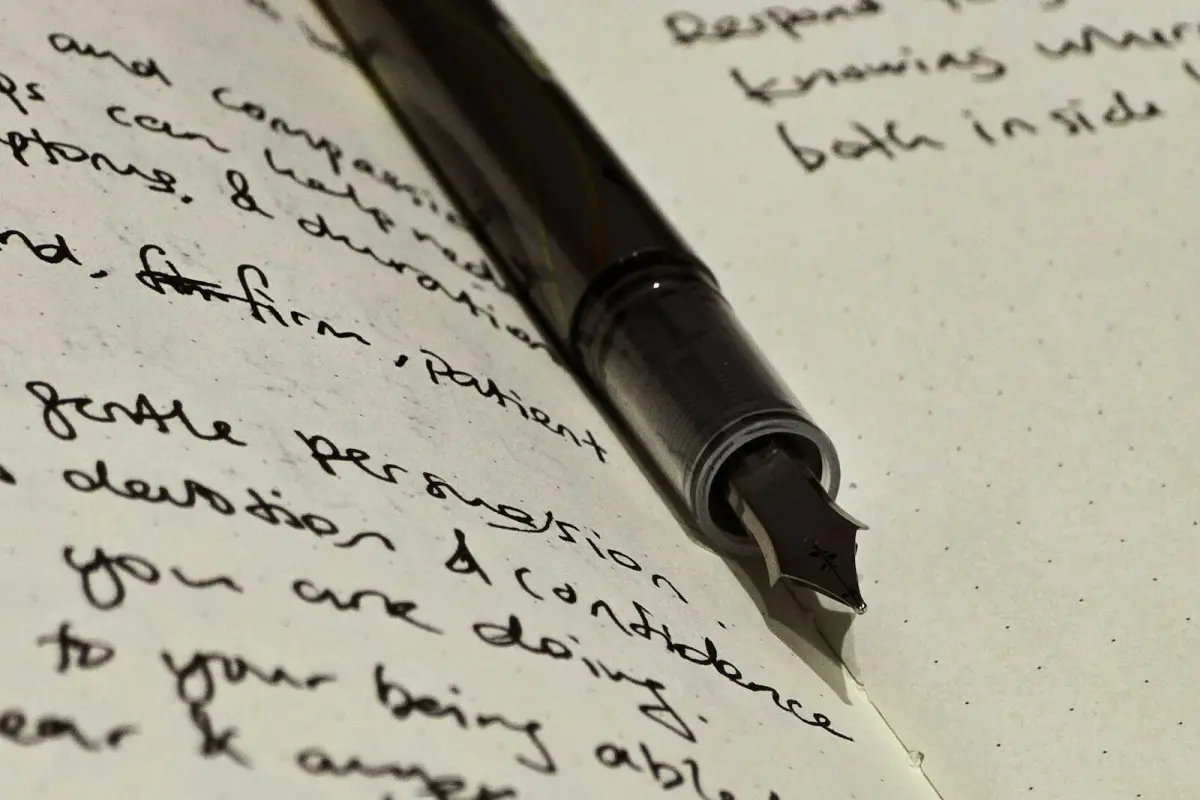
Call it 220 words for a college-ruled page in average handwriting. That figure sits in the middle of a range running from 145 to 328, and where you land in that range has almost nothing to do with your paper. It depends on how big your letters are.
Which is why the single number you came here for does not exist, and why every site that prints one is guessing on your behalf. Your own figure does exist. Counting three pages will find it, and the calculator below turns it into a word count for the whole notebook.
The 250 rule is a typewriter number
Ask the web how many words are on a handwritten page and you get 250. That number was never about handwriting.
It describes a typed manuscript page: twelve-point monospaced type, double spaced, one inch margins. Under those conditions the estimate held up well enough for decades, because every one of those conditions was fixed. William Shunn, whose formatting guide has been the reference for English-language manuscripts since the 1990s, retired the rule in 2021 and answered a reader whose case shows the damage. The reader had 275 pages, multiplied by 250, and reported 66,000 words. His editor ran a real word count: 91,000.
An estimate that misses by 38 percent on typed pages with fixed formatting will not do better on paper where the formatting is your wrist. So the rule did not become unreliable for handwriting. It was never reliable for it, and nobody checked.
What actually fits on a page
Two things decide it. The lines are the easy half.
American ruled paper comes in three widths and the manufacturer figures agree with each other: college ruled is 9/32 inch, about 7.1 mm, giving roughly 33 lines a page; wide ruled is 11/32 inch or 8.7 mm and about 27 lines; narrow ruled is 1/4 inch or 6.35 mm and about 38 lines. Count your own anyway, because you rarely fill the top and bottom lines and that is the number the calculator wants.
The harder half is how many words go on one line, and that follows from the width of your letters. US Letter gives you 8.5 inches across. Subtract the usual 1¼ inch left margin plus whatever you leave on the right, and you are writing inside roughly 6.7 inches, call it 170 mm. Now write “abcdefghij” in your ordinary hand and measure those ten letters. Forty millimetres means 4 mm a letter, so about 42 characters reach the right edge.
Turning characters into words is the step where most guides start guessing. I calculated it instead. The material is the five English articles on this blog, 7,389 words of running prose; I re-wrapped them paragraph by paragraph at fixed line widths, cut the result into pages of 33, 27 and 38 lines, and counted the words on every page.
| Letter width | Characters per line | College ruled, 33 lines | Wide ruled, 27 lines | Narrow ruled, 38 lines |
|---|---|---|---|---|
| 5.0 mm, large hand | 34 | 178 | 145 | 205 |
| 4.5 mm | 37 | 193 | 158 | 222 |
| 4.0 mm, average | 42 | 220 | 180 | 254 |
| 3.5 mm | 48 | 248 | 203 | 285 |
| 3.0 mm, small hand | 56 | 285 | 233 | 328 |
Down the middle of that table the old rule survives: 220 words on college ruled is close enough to 250 that an average hand on the most common paper in America can go on using it without coming to much harm.
The corners are where it falls apart. A large hand on wide-ruled paper gets 145 words onto the sheet, 42 percent below the rule, while a small hand on narrow-ruled paper fits 328 onto a sheet of the same size, 31 percent above it. Both notebooks came off the same shelf in the same store, and the two writers are out by a factor of 2.3 from each other before anyone has written a word.
Why sampling three lines is a bad idea
Almost every guide that gets this far tells you to count three lines, take the average and multiply by the number of lines on the page. Two minutes saved, and rather more accuracy lost than the advice lets on, for a reason that also tells you what to do instead.
Prose does not fill lines evenly. A paragraph ends wherever it ends, usually mid-line, and since the paragraphs in this material run to 42 words apiece, something like one line in six at 42 characters wide is a stub rather than a full line.
Stubs are what wreck a three-line sample. The average line in the material holds 6.70 words, but with a standard deviation of 1.74 around it, so consecutive lines differ by a quarter of their length as a matter of course; pull three of them at random, scale up to a 33-line page, and roughly 15 percent of uncertainty comes along for the ride. Five lines will get you to 12 percent, ten lines to 8, at which point you have spent longer sampling than you would have spent counting the page.
So count the page. The stubs are already inside it, and what survives is the far gentler variation between one page and the next: ten words on an average of 220, call it 4 percent, which three counted pages push down to about 2.5.
Stopping at three is deliberate. Pages four through six are worth roughly one more percentage point between them, which is a poor trade for another half hour with a pencil and a page of tally marks.
One caveat that matters more than any of the figures above. All of this comes out of typeset prose rather than anybody’s actual notebook, and real handwritten pages scatter further, because a heading eats two lines, a struck-out sentence eats none, and the margin fills up with afterthoughts that may or may not be part of the draft. Four percent is a floor, not a forecast.
Ten minutes, step by step
Write “abcdefghij” in your normal hand, measure it, divide by ten.
Count the lines you actually fill on a page. Not the lines printed on the paper: the ones your writing reaches.
Count three full pages, and take them from three different sessions rather than three consecutive sheets.
Put the three numbers into the calculator above.
Write the answer inside the front cover, with today’s date next to it.
Step three is doing most of the work here, and it is the step nearly every guide leaves out. Consecutive pages resemble one another because letter size drifts across an evening and shifts again the moment you pick up a different pen, so pages 12, 40 and 71 describe your notebook while pages 12, 13 and 14 describe a single Tuesday night in October.
As for step five: it looks like fussiness and it is the whole difference between a measurement and a memory you will end up re-guessing in March.
A worked example
You have filled 63 pages of a college-ruled notebook with a fairly small hand, 3.5 mm to the letter. The table gives 248 words a page, and three counted pages come out at 251, 238 and 259, close enough that you keep your own average of 249.
Sixty-three times 249 is 15,687 words. At 250 words to a standard manuscript page that is 63 manuscript pages, a coincidence of your paper rather than a rule. More usefully: if the finished piece needs 40,000 words, you are 39 percent of the way there, and the writing goal calculator will tell you what the remaining 24,313 words cost per writing day.
Notice how much rests on 249 rather than 250. Had you used the old rule at face value on a large-handed wide-ruled notebook, the same 63 pages would have read as 15,750 words when the truth was closer to 9,000.
When your number stops working
Dialogue breaks it first. Every line of speech is its own paragraph and ends in a stub, so a dialogue-heavy page in a novel draft carries visibly fewer words than a page of description written by the same hand on the same evening.
Revision breaks it differently. Struck-out paragraphs go on occupying pages while contributing no words at all, and once you are correcting on paper, page count has stopped measuring anything you care about.
The rest are smaller and easier to spot:
A new notebook, a new ruling, a new figure. Measure again.
A broad nib writes larger than a fineliner, so two pens mean two figures.
Handwriting tends to grow late in a session, which means counting only the first page of an evening flatters you.
You may not need the conversion at all
Here is the part that argues against this article. If you write by hand and never type it up, pages are a perfectly good unit, and converting them into words adds a step and an error bar for no benefit. Track pages. Set your goals in pages.
The conversion earns its keep the moment somebody else’s number enters the picture: a publisher’s word range, a course requirement, a competition limit, a daily quota you set in words because that is how the app counts. Then you need a bridge between the paper and the target, and it had better be your bridge rather than a stranger’s rule of thumb.
And if neither case applies, the honest answer may be that pages are not your unit at this stage at all. words, hours or pages works through which of the three fits which phase of a project.
A4 pages hold fewer words
Two things change if your paper is A4 instead of Letter, and both push the same way.
European ruled paper follows DIN 16552-1, which sets the common A4 rulings at 9 mm between lines. That is wider than college ruled, so an A4 sheet takes about 27 to 29 written lines even though the paper is taller than Letter. Its writing area is narrower too: 155 mm against your 170.
Then there is the language. German words in the same measurement run to 6.58 characters against 5.64 in English, about 17 percent longer. Put the two together and an A4 page in average German handwriting comes to roughly 137 words, a little over 60 percent of what the American college-ruled page holds. An American conversion table applied to a European notebook stacks both errors in the same direction.
Do headings and margin notes count?
Whatever you count while sampling is what your figure means. Include headings on all three sample pages or on none of them; mixing the two widens your spread for no reason at all.
I write on unlined paper. What do I do?
Count the lines you produced on a filled page and use that as your line count. It varies more without ruling, which makes the third sample page mandatory rather than merely advisable.
Can I photograph the pages instead of counting them?
Several writing apps read handwritten pages through the camera. Check the result against one page you counted yourself before trusting it for a whole notebook, because recognition errors in handwriting cluster on particular letters instead of spreading out.
How many words an hour can I write by hand?
A different question, and a poorly answered one. Most of the published figures measure copying speed, which tells you little about the speed of composing. Time your own sessions for a week and you will know more than the literature does about you.
My three pages came out 30 words apart. Is that normal?
On a 220-word page, yes. That is a spread of about 14 percent, wider than typeset prose but ordinary in a notebook where one page held a heading and another ran to the last line.
What to do with this
Count three pages tonight, feed them to the calculator, and write the figure in the front of the notebook. After that every page count converts, and the conversion is yours rather than a guess: how many words a day is realistic says whether your pace holds up, and the writing goal calculator turns a deadline into a daily quota.
Where to keep the numbers afterwards is covered in how to track writing progress, and which unit fits your project in what a writing tracker is. Further conversions live under Word goals & metrics.