

Morning Pages: The Rules, the Word Count and the Evidence
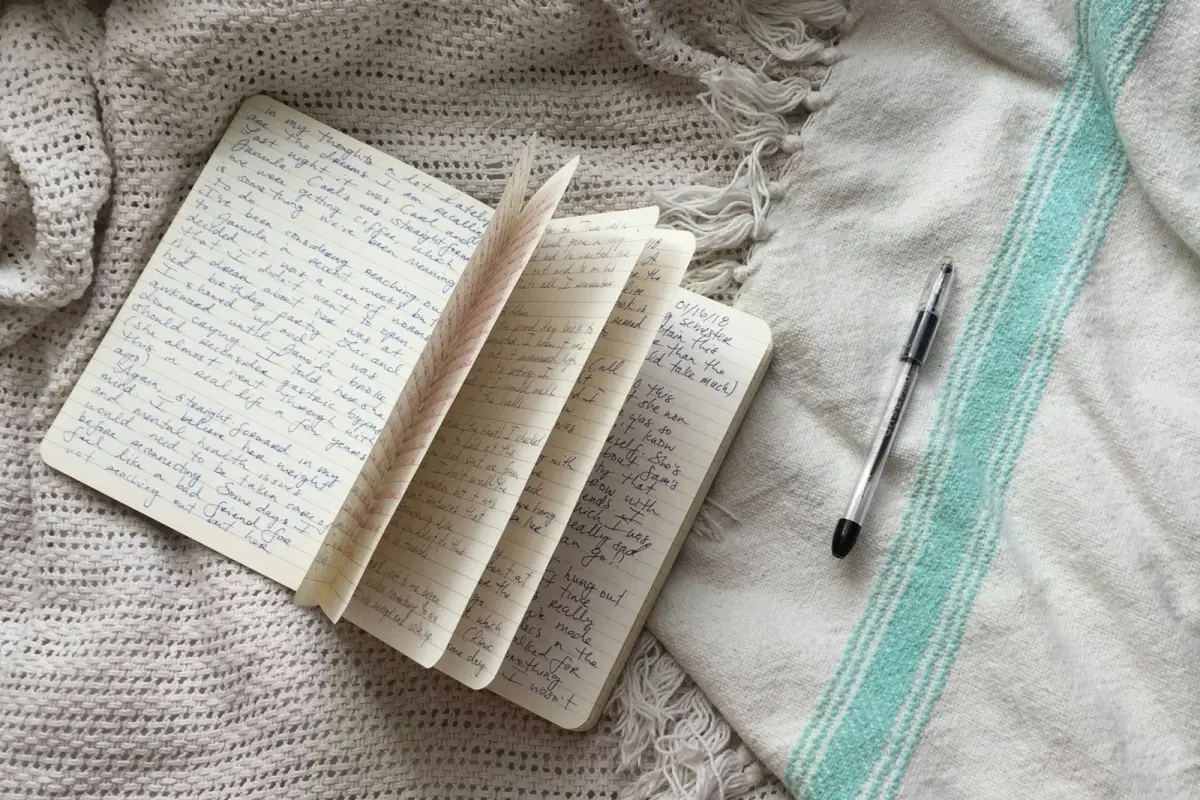
Morning pages are “three pages of longhand, stream of consciousness writing, done first thing in the morning”, in the words of Julia Cameron, who introduced them in her 1992 book The Artist’s Way. In a blog post of 20 September 2012, Cameron put the daily cost at “about 30-40 minutes” (archived copy). A PubMed search for the phrase “morning pages” on 9 November 2026 returned the notice that the phrase is not in the index, and I found no trial of the practice under that name.
The nearest research is on expressive writing, where Joanne Frattaroli’s 2006 meta-analysis of 146 randomized studies reported an average effect of r = .075. The figure of 750 words that many guides attach to morning pages goes back to a website Buster Benson launched on 16 December 2009. By WriteZone’s own calculation, three pages in an average hand on college-ruled paper hold about 670 words.
What Julia Cameron’s own pages prescribe
Cameron kept the rules on a page of her website titled Morning Pages, which the Internet Archive saved on 23 December 2022 (archived copy). The page calls morning pages “the bedrock tool of a creative recovery” and says they are “not high art” and “not even ‘writing.’” Their subject is “anything and everything that crosses your mind”, they are “for your eyes only”, and “there is no wrong way” to do them. The page ends with the instruction to “just put three pages of anything on the page…and then do three more pages tomorrow.”
Her post of 20 September 2012, “Morning Pages: why 3 pages?”, adds the format. The pages are “three, single-sided, 8.5x11 pages (so in other words, not 6 pages)”, and Cameron writes that “they must be done in the morning” and “must be done by hand”. In the same post she says that “the first page and a half is pretty easy” and that the second page and a half “is more difficult, but it moves us into action”. The next sentence reads “More than three pages invites self-obsession.”
A post of 21 February 2012, “Writing By Hand”, states that morning pages “need always be done by hand” (archived copy). Cameron writes there that “writing by computer is a more shallow practice” which “yields us speed and distance, but not the depth that we are looking for.” On 9 November 2026 the address of the rules page answered with a 301 redirect to a lesson in Cameron’s video course The Right to Write, which asks for a login, and both posts from 2012 returned a 404 error. The links in this article therefore point to the Internet Archive.
Where the 750-word figure comes from
Buster Benson announced 750 Words on his blog on 16 December 2009, in a post titled “750 words a day, or a defense of private, unfiltered, unplanned writing” (Buster Benson). “Over the last couple days I thought of, and built, a site”, he wrote, and the premise was “to write 750 words a day”. According to the post, the site “was highly inspired by a thing called Morning Pages from The Artist’s Way”. Benson gave two reasons for putting it online, that he worked on “3 or 4 different computers” and that “my hand has forgotten how to write long hand.” He also reported his own record from a private wiki over the previous year, writing on “81 of the last 300 days”, and a bowling-style point system in which “3 days in a row is a turkey”.
The page that explained the number is still online as the original 750 Words site. There Benson writes that “250 words per page is considered to be the standard accepted number of words per page”, so three pages make 750. He adds that if the domain 750words.com had been taken, he “would’ve totally found a way to prove that 249 words per page was the accepted standard.” The same page says he does not know if his hands “even work anymore with pen and paper for any task that takes longer than signing a check or credit card receipt.”
Benson’s 250 words are a convention for typed manuscript pages. For handwriting, WriteZone calculated words per page in the article How Many Words Is a Handwritten Page?. The calculation re-wrapped 8,926 words of English prose at the line widths of handwriting from 3 to 5 millimetres per letter and cut the result into US Letter pages of 33 lines (college ruled) and 27 lines (wide ruled). The table multiplies those page figures by three.
| Handwriting (letter width) | College ruled, per page | Three pages | Wide ruled, per page | Three pages |
|---|---|---|---|---|
| large (5.0 mm) | 178 | 534 | 146 | 438 |
| average (4.0 mm) | 222 | 666 | 181 | 543 |
| small (3.0 mm) | 290 | 870 | 237 | 711 |
By that calculation, three college-ruled pages in an average hand hold about 670 words and three wide-ruled pages about 540. An average hand on narrow-ruled paper with 38 lines reaches 255 words a page in the same article, or 765 for three pages, the one combination within a few words of Benson’s 750. Benson’s typed daily target of 750 words would fill about 3.4 college-ruled pages in an average hand, and a little over four wide-ruled ones.
How other writers changed the rules
Chris Winfield’s guide has been online since at least August 2014, when the Internet Archive first saved it, and its page metadata gives 17 July 2018 as the date of publication (Chris Winfield). It was the first result for “morning pages” on google.com with US settings when WriteZone checked on 9 November 2026. Winfield writes that he had kept up the practice “for the last 241 days” and had “missed doing them twice”, and that on those two days he “was a bit more anxious”. He asks himself whether that could be “the Placebo effect” and answers “Possibly”. His guide repeats Cameron’s “about 30-40 minutes” and her claim that the pages “actually make more time than they take”.
The author Nancy Butts wrote on her Goodreads blog on 4 December 2014 that she types her freewriting on an iPad with an external keyboard. She gives three reasons, namely that a notebook is less private than a password-protected computer, that “I don’t want to waste paper”, and that since “neck fusion surgery two years ago” writing more than a paragraph by hand has been painful.
Shelby Abrahamsen of Little Coffee Fox first published her guide on 19 June 2016 and last updated it on 6 December 2024. She calls “one crucial rule” the instruction “Do not let anyone, and I mean anyone, read your work”, and suggests that readers “hold off on reading it yourself for a couple of months.” Some of her readers, she reports, keep their journals “in a secure safe”, while others burn or shred the pages “after each session”. On timing, her advice is “if mornings don’t work, try afternoons or evenings”.
Austin Kleon described his own variation on 7 December 2020. He writes things down “all day in a pocket notebook”, fills out a logbook the next morning and then writes “longhand about yesterday”. On mornings when he does not know what to write about, he answers a prompt he calls “The Best Thing” or will “draw until I feel like writing”. He also uses what Janet Burroway calls “clustering” in Writing Fiction, “starting in the middle of a page, writing a word, putting a box or circle around it”, until the page holds “a tree or web”.
Gabriela Pereira of DIY MFA did the twelve weeks of The Artist’s Way in the fall of 2003 and wrote on 14 October 2025 that she now calls her practice “journaling”. She writes five or six pages on some days and half a page on others, and reports “journaling consistently for 944 days (with a few days skipped here and there because of travel and other commitments)”. Her notebooks since childhood, starting with one titled “My Diary” that an aunt gave her at the age of ten, number “at least forty or so”.
Do morning pages work?
The nearest evidence comes from studies of expressive writing. Frattaroli, then at the University of California, Riverside, pooled 146 randomized studies of “experimental disclosure” in Psychological Bulletin in 2006 (Frattaroli 2006). She reports a “positive and significant average r-effect size of .075”.
Kitty Klein and Adriel Boals at North Carolina State University published “Expressive writing can increase working memory capacity” in 2001, based on “2 semester-long experiments” (Klein and Boals 2001). In the first, 35 freshmen who wrote “about their thoughts and feelings about coming to college” showed larger working memory gains seven weeks later than 36 writers given a trivial topic, and more “cause and insight words” went with greater gains. In the second, 34 students who wrote about “a negative personal experience” showed greater gains and “declines in intrusive thinking” compared with 33 who wrote about a positive experience and 34 who wrote about a trivial topic.
Monika Sohal and colleagues in Calgary published a meta-analysis of journaling for mental health in March 2022 (Sohal et al. 2022). Out of 3,797 articles, 20 randomized controlled trials on PTSD, other anxiety disorders and depression met their criteria. The authors find “a small to moderate benefit” and write that “high degrees of heterogeneity and methodological flaws” limit their ability to state its size.
Frattaroli’s abstract defines disclosure as writing about “personal and meaningful topics”, Klein and Boals assigned the start of college or a negative experience, and Sohal’s 20 trials dealt with PTSD, anxiety and depression. Cameron’s archived rules page asks for three pages on “anything and everything that crosses your mind”, a format none of these studies assigned.
Longhand or typing
The study most often cited for the pen is Pam Mueller and Daniel Oppenheimer’s 2014 paper “The Pen Is Mightier Than the Keyboard”, in which students who took lecture notes on laptops “performed worse on conceptual questions” (Mueller and Oppenheimer 2014). Heather Urry and a team at Tufts University repeated its first study directly in 2021, with 74 participants on laptops and 68 writing by hand (Urry et al. 2021). Laptop notes contained more verbatim text, yet the laptop group “did not perform better” than the longhand group on the quiz, and exploratory meta-analyses of eight similar studies in the same paper “echoed this pattern”.
Ruud van der Weel and Audrey van der Meer at the Norwegian University of Science and Technology in Trondheim recorded 36 students with a 256-channel EEG in a study published in January 2024 (van der Weel and van der Meer 2024). Writing words with a digital pen produced “far more elaborate” connectivity between brain regions than typing them. The study measured brain connectivity while participants wrote single words, and it did not measure learning or thinking.
Urry’s 142 participants took lecture notes and van der Weel’s 36 wrote single words, and none of the participants in these studies wrote morning pages.
Can you write morning pages at night?
Cameron’s post of 20 September 2012 says the pages “must be done in the morning”. Abrahamsen’s guide, in the version of 6 December 2024, says “if mornings don’t work, try afternoons or evenings”. Neither page cites a study on time of day.
The closest study is a sleep-laboratory experiment by Michael Scullin and four co-authors from Baylor University and Emory University, published in the Journal of Experimental Psychology: General in January 2018 (Scullin et al. 2018). According to the PubMed abstract, 57 “healthy young adults (18-30)” wrote for 5 minutes before overnight polysomnography. They were randomly assigned to list tasks they needed to complete “the next few days” or tasks they “had completed the previous few days”. The to-do group “fell asleep significantly faster”, and “the more specifically participants wrote their to-do list, the faster they subsequently fell asleep.”
The authors call the second condition “journaling about completed activities”, and the 57 participants were split between two writing tasks, with no group that skipped writing. Their abstract recommends “a very specific to-do list for 5 min at bedtime”, between a sixth and an eighth of the 30 to 40 minutes Cameron gives for three morning pages.
Morning pages vs journaling
Cameron’s archived rules page of 2022 sets three pages, first thing in the morning, and says the pages are not “writing”. Pereira’s post of 14 October 2025 describes five or six pages on some days and half a page on others, under the name “journaling”. Sohal’s meta-analysis of March 2022 counts 20 trials of journaling, none of them with Cameron’s three pages or her morning slot, and Scullin’s 2018 abstract uses “journaling” for a five-minute list of completed tasks.
When morning pages are the wrong tool
Cameron’s figure of “about 30-40 minutes” sets the first limit, since a morning with 15 free minutes covers 38 to 50 percent of one session. Winfield’s 239 sessions in 241 days at that length add up to roughly 120 to 160 hours.
Cameron’s archived rules page says morning pages are not “writing”, so 670 words of morning pages a day add nothing to a 90,000-word novel draft. WriteZone’s guide to building a writing habit sets out a 30-day routine for the project itself.
For writer’s block, the 2022 survey by Sarah Ahmed and C. Dominik Güss and Robert Boice’s 1983 trial are covered in Writer’s Block: What the Research Actually Shows, and neither tested morning pages.
A four-week test
Four weeks of three pages a day comes to 84 pages, about 18,600 words in an average hand on college-ruled paper. At Cameron’s 30 to 40 minutes a session, that is 14 to almost 19 hours.
The record for such a test needs three numbers a day, namely pages, minutes and words written on the main project afterwards. A writer with 600 project words a day in October and 700 a day in a November with morning pages would see a difference of 100 words, or about 17 percent, for one person and one month. Writing Streaks: What a Missed Day Really Costs covers how missed days in such a run affect the totals.
What do I write in morning pages?
Cameron’s archived page says they are about “anything and everything that crosses your mind”, and that there is no wrong way to do them. Austin Kleon wrote on 7 December 2020 that when he does not know what to write about, he answers a prompt he calls “The Best Thing” or draws until he feels like writing.
Should I reread my morning pages?
Cameron’s site says only that the pages are for your eyes only. Little Coffee Fox advises waiting a couple of months, and Pereira dips back into old notebooks only now and then. There is no research on either habit.
Do I have to write them every day?
Cameron’s rule is three pages every morning. No study links a particular frequency to any outcome, and Pereira’s 944 days included a few skipped ones.
Can I write morning pages on an iPad with a stylus?
Cameron asks for handwriting and says nothing about the surface. In the Trondheim study, the handwriting condition was exactly that, a digital pen on a touchscreen.
Why do some people say morning pages are bad for them?
Cameron herself warns that more than three pages “invites self-obsession”. Beyond that warning there are personal accounts in both directions and no data on who benefits and who does not.